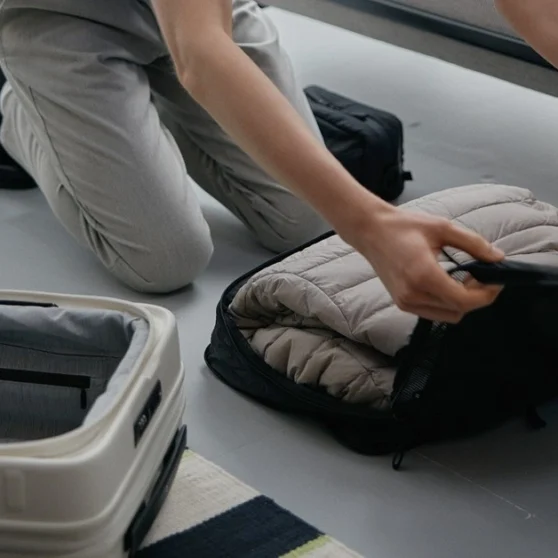
Stand in the concourse of any major transit hub—Shinjuku, King’s Cross, or Grand Central—on a Thursday evening, and you will notice a distinct shift in how people carry their lives. The hard-edged briefcases from the week have largely disappeared, and are replaced by a chaotic assortment of overstuffed totes, technical alpine backpacks in urban settings, and canvas shoppers doubling as laptop sleeves.
We are living in the era of the hybrid work lifestyle. Modern life rarely separates cleanly into distinct categories anymore. Work overlaps with travel; errands blend seamlessly into evening meetings. A weekday afternoon can easily blur into a short weekend departure. Yet, despite this fluidity, many of us carry the exact same setup into every context—leaving us weighed down with unnecessary items on some days, and entirely underprepared on others.
Most people believe they need more bags to solve this problem. What they actually need is a system.
When deciding how to choose the right bag, the answer isn’t found in endless accumulation. It is found in editing. Enter the Two-Bag Rule: a highly intentional, minimalist bag system designed to strip away friction. It relies on a simple philosophy. You only need one bag for structure, and one bag for fluidity. Nothing more.
Bag One: The Architecture of Structure
The first bag is deliberate. It carries the weight of your routine.
This is the vessel that moves predictably from your home, to the train, to the office, and perhaps to a café in between. It must hold your commuting bag essentials—a laptop, chargers, a notebook, a structured folio..
Because of its cargo, this bag requires architecture. It should feel stable, balanced, and designed to support deep focus. This bag benefits heavily from internal compartments that create physical separation. It respects the fact that professional life requires a certain level of containment; when your tools are categorized, you do not waste time searching for a misplaced pen or untangling a charging cable at the start of a meeting.
Structure, however, should not be confused with rigidity. The best structured bags are tactile and adaptive. A piece like the Niru Daypack exemplifies this balance—offering the quiet durability and compartmentalized discipline required for the workday, without looking overly corporate when you step out for a lunch meeting. It provides reliability when you need it most.
Bag Two: The Freedom of Fluidity
The second bag exists purely for the unplanned.
Weekends. Short overnight trips. Sunday mornings spent at the market, or evenings that extend unexpectedly beyond a dinner reservation. This bag carries lighter, more transient loads—a book, a water bottle, a camera, an extra layer for when the temperature drops.
If the first bag is about containment, the second is about openness. Fluidity requires fewer compartments and more flexibility. It should be a truly travel-ready bag that adapts to environments that shift by the hour. A canvas tote or a soft-sided nylon sling, like those found in the wider Niru collection, acts as an extension of your own movement rather than an object that anchors you down. It expands when needed and compresses when empty.
The Friction of Transition
Often, the debate centers around a work bag vs a weekend bag, as if they are opposing forces that never interact. But the true genius of the Two-Bag Rule is not about what each bag holds individually—it is about the transition between them.
The most important question you can ask of your everyday bag system is this: How quickly can I move my life from one to the other?
If switching between work and leisure requires unpacking half your life, dumping contents onto a bed, and meticulously reorganizing, your system is flawed. The transition should be frictionless. Your core essentials—wallet, keys, phone, perhaps a single pouch holding your lip balm and transit card—should slide effortlessly from the structured compartments of your weekday pack into your weekend bag.
This is why many modern carry designs, including the modular ecosystems explored across LOJEL’s collections, lean heavily into light construction and thoughtful proportions. They provide enough structure to support your ambition, and enough openness to adapt to your leisure. But the design of a bag only succeeds if the user respects the rhythm of the system.
Carrying With Intention
Most of our daily friction comes from redundancy. We accumulate two chargers, three notebooks, and more trinkets that never leave the dark corners of our backpacks. When you apply the Two-Bag Rule, you naturally begin to edit. You stop resetting your life every Friday evening, and instead, you simply transition.
This approach is less about fashion and more about philosophy. It suggests that life, even in its most chaotic and demanding forms, can be simplified into contexts.
Structure when you need focus. Fluidity when you need openness. The rest is just noise.